 Koru
KoruSales Performance Review Examples That Show Real Impact
Sales performance review examples for quota, pipeline, discovery, forecasting, customer follow-up, and missed targets, with evidence-based rewrites and a worksheet.
Good sales performance review examples do more than say, "hit quota" or "built strong relationships." They connect the number to the work behind it: the customer problem, deal stage, action taken, evidence, and what should happen next.
Use this structure:
Sales review formula
Structure
Example
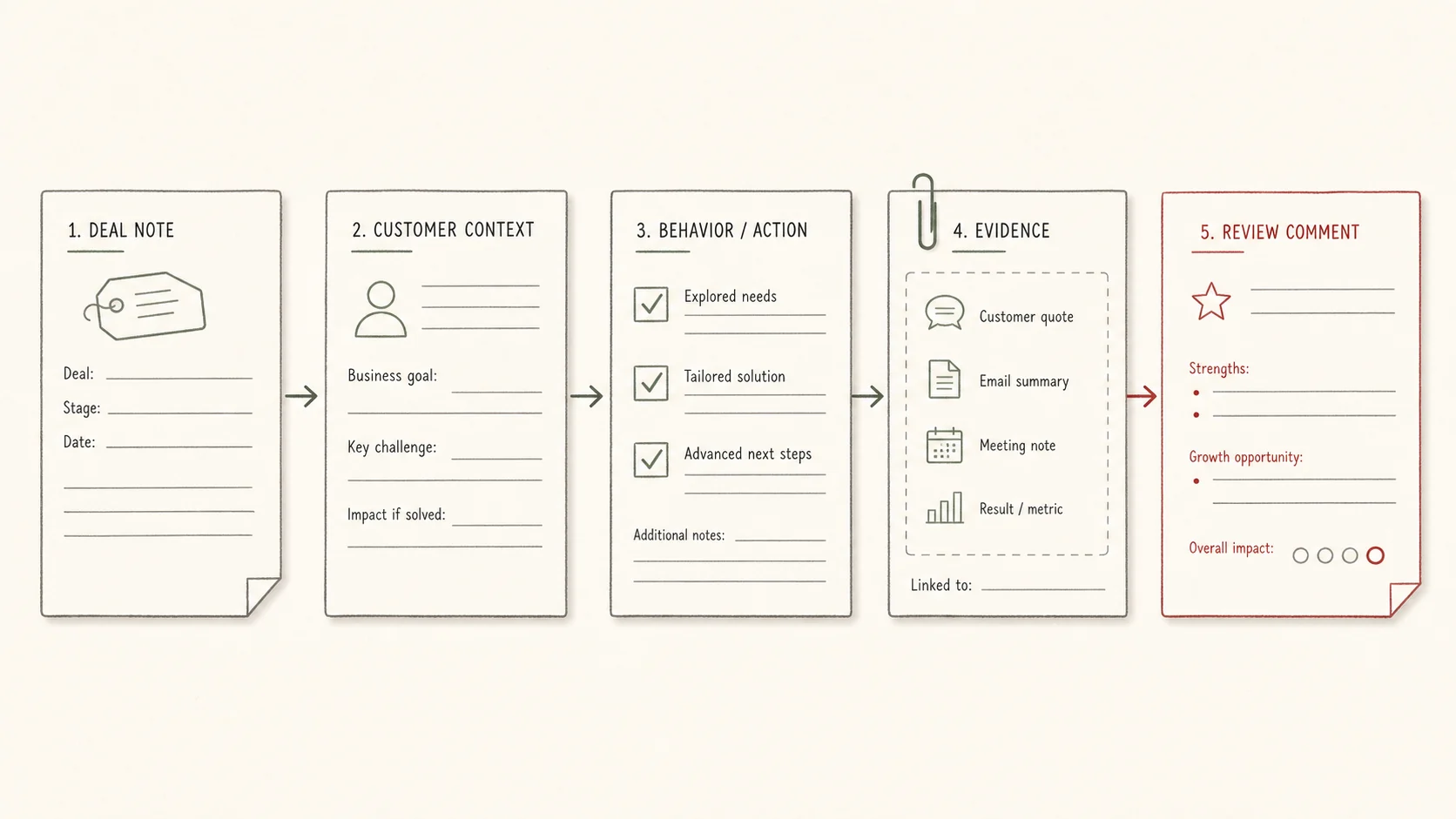
The review comment is the last step. Capture the deal moment, add customer context, name the behavior, attach evidence, then write the sentence.
That is the short answer to "sales performance review examples": show the number, then show why the number happened. A sales review without metrics feels thin. A sales review with only metrics can still miss the judgment, persistence, customer work, and team handoffs behind the result.
Sales performance review examples you can adapt
Use these as starting points. Replace the bracketed details with real accounts, segments, deal stages, dates, customer problems, activity, and outcomes.
| Review area | Generic version | Evidence-based version |
|---|---|---|
| Quota attainment | "I exceeded my sales target." | "I finished [period] at [result] against target. The biggest driver was [segment/account type], where I focused on [specific action] and moved [number/type of deals] from [stage] to [outcome]." |
| Pipeline quality | "I built a strong pipeline." | "I improved pipeline quality by removing stale opportunities, documenting next steps for [deal group], and focusing follow-up on accounts with [buying signal or customer problem]." |
| Discovery | "I ran better discovery calls." | "In [deal/customer group], I changed discovery by asking for the business impact before demoing. That helped us qualify out [type of weak fit] earlier and focus time on [better-fit opportunity]." |
| Follow-up | "I was persistent with prospects." | "For stalled late-stage deals, I sent follow-up that named the open decision, owner, and risk. That made the next step clearer for [customer/stakeholder] instead of adding another generic check-in." |
| Forecasting | "My forecasts were reliable." | "I made forecast changes earlier by flagging [risk] during [meeting/report]. That gave the team time to adjust expectations before the end of the period." |
| Collaboration | "I worked well with other teams." | "I brought Support into [account/deal] before the renewal call because [customer concern] kept surfacing. Their answer helped us address the implementation risk directly." |
| Missed target | "I learned from a tough quarter." | "I missed [target] by [gap]. The controllable issue was [behavior/process]. I have changed [specific habit] so weak-fit deals are identified by [stage/date] next cycle." |
The stronger versions are not padded. They are more useful because a manager can inspect them, question them, and turn them into next-cycle goals.
Weak-to-strong rewrites for sales reviews
Sales reviews often drift into two weak patterns: a number with no story, or a story with no evidence. Keep both.
Too thin
"I had a strong quarter and built good customer relationships."
Review-ready
"I finished Q2 above target, mainly from mid-market renewals that had stalled in legal review. I kept each account moving by writing a weekly next-step note with the buyer, legal owner, and unresolved implementation question."
Too inflated
"I transformed the sales process through exceptional stakeholder management."
Specific
"I changed the handoff for expansion deals by adding a 15-minute Support review before the proposal call. That helped us answer implementation questions before they slowed down procurement."
Too defensive
"I missed quota because the market was slow and several prospects delayed decisions."
Accountable
"I missed quota by [gap]. Some deals delayed because budgets moved, but I also kept two low-fit opportunities in commit too long. Next quarter, I will move deals out of commit unless the buyer, timeline, and decision criteria are confirmed."
Positive sales performance review examples
Positive examples should still name the work. "Great closer" sounds good, but it does not tell anyone what to repeat.
Quota
"You exceeded target in [period] by focusing on [segment/account type] where the customer problem was already clear. The strongest part was how you qualified budget and timing before investing more team time."
Pipeline discipline
"You cleaned up the pipeline instead of protecting an optimistic forecast. Removing weak-fit deals made the remaining opportunities easier to review and helped the team see the real risk earlier."
Discovery
"Your discovery calls improved because you stopped leading with the demo. In [account], you clarified the cost of the current workflow first, then tied the next call to that problem."
Customer follow-up
"Your follow-up after the proposal call was specific. You named the open decision, assigned the next owner, and gave the buyer a clean summary they could forward internally."
Constructive examples for missed sales targets
Constructive sales feedback should avoid vague labels like "not hungry enough" or "needs better urgency." Those phrases are hard to act on and easy to argue with.
| Situation | Weak comment | Fairer comment |
|---|---|---|
| Missed quota | "You need to work harder next quarter." | "You missed target by [gap]. The part we can change is early qualification: three commit deals had no confirmed decision criteria by week six. Next quarter, I want those criteria documented before a deal enters commit." |
| Poor forecast | "Your forecast was unreliable." | "The forecast changed late because [deal] stayed in commit after the buyer stopped responding. For the next cycle, move a deal out of commit when the next meeting, owner, or business case is missing." |
| Weak handoff | "You need to collaborate better." | "Implementation joined after the proposal had already been sent, so their concern became a late blocker. Bring them into expansion deals before pricing is finalized when setup risk is part of the sale." |
| Low activity quality | "You need more activity." | "More outreach will not fix weak targeting. The issue this period was that too many first meetings came from accounts without [fit signal]. Let's tighten the account list before increasing volume." |
The point is not to soften the feedback. It is to make the next behavior visible.
Manager comments vs self-review comments
A manager comment and a self-review can use the same evidence, but they should not sound identical.
| Evidence | Manager comment | Self-review version |
|---|---|---|
| Renewal saved after implementation risk surfaced | "You handled the renewal well because you brought Support into the conversation before the risk became a pricing objection." | "The renewal was at risk because the buyer was worried about implementation. I brought Support into the call early, clarified the handoff, and kept the deal moving without discounting first." |
| Forecast corrected early | "You made the forecast more useful by lowering confidence on [deal] before the final week." | "I changed my forecast discipline this quarter. When [deal] lost its confirmed next step, I moved it out of commit instead of hoping it would close." |
| Pipeline cleanup | "You made the pipeline review cleaner by removing stale opportunities and documenting next steps on the remaining late-stage deals." | "I cleaned up my pipeline by removing stale opportunities and writing next steps for each late-stage deal. That made my forecast less optimistic but more accurate." |
A worksheet for writing sales review comments
Before you write the final comment, fill in the fields that apply. You do not need every field for every example. You need enough evidence that the sentence does not depend on adjectives.
| Prompt | Notes |
|---|---|
| What was the sales context? | Quarter, quota period, segment, territory, account type, renewal, expansion, new business |
| What was the customer problem? | Pain point, risk, internal blocker, timing issue, budget concern, competing priority |
| What action did you take? | Discovery change, follow-up, stakeholder map, proposal adjustment, handoff, escalation |
| What evidence do you have? | Target result, deal stage movement, account example, buyer reply, forecast change, handoff artifact |
| What did you learn? | Better qualification, earlier risk flagging, tighter targeting, clearer handoff, stronger discovery |
| What happens next? | Repeat, change, stop, ask for support, set a goal, review with manager |
How to gather sales evidence during the quarter
For a salesperson, a useful weekly note can be short:
Enterprise renewal looked stalled after Legal raised implementation risk. Brought Support into the buyer call before discounting. Buyer asked for a revised rollout note, not lower pricing. Next time, invite Support before procurement if setup risk is already visible.
Later, that becomes review language:
"In the enterprise renewal, I kept the deal moving by addressing implementation risk directly instead of discounting first. Bringing Support into the buyer call changed the next step from price negotiation to rollout planning."
That is Koru's angle on sales performance reviews: keep the context behind the number while it is still fresh. A CRM can show the stage change. Your notes explain the judgment behind it.
Related reading
Comparison
Notion Career Journal Template vs Koru
Compare a Notion career journal template with Koru for career tracking, brag documents, STAR stories, and interview preparation.
Comparison
Koru vs Spreadsheets for Career Tracking
Compare Koru with Google Sheets and Excel for tracking career achievements. Learn why free spreadsheets often fail for career journaling and what makes purpose-built tools stick.
Career Development
Best Career Journal Apps in 2026
Compare the top career journaling apps for tracking achievements, preparing for interviews, and building your professional narrative. Tested and reviewed by career development experts.
Professional Development
Best Achievement Tracking Tools in 2026
Compare the best tools for tracking work accomplishments, building brag documents, and preparing for performance reviews. Reviews include AI-powered trackers and traditional methods.