 Koru
KoruPerformance Review Comments Examples That Do Not Sound Generic
Performance review comments examples for managers, peers, and self-reviews, with evidence-based rewrites, a comment formula, and a worksheet.
Good performance review comments do four things: name the situation, describe the behavior, show the impact, and point to what should happen next.
Use this formula:
Review comment formula
Structure
Situation + behavior + evidence + next step
Example
"During the beta launch, you sent weekly risk notes that gave Product and Support one shared view of open decisions. For the next launch, keep that rhythm and add an owner for each unresolved dependency."
That is the short answer to "performance review comments examples." A useful comment is not a personality label like "great communicator" or "needs more ownership." It is a small piece of evidence your manager, employee, or review panel can understand later.
So do not start by asking, "What sounds professional?" Start with, "What actually happened?"
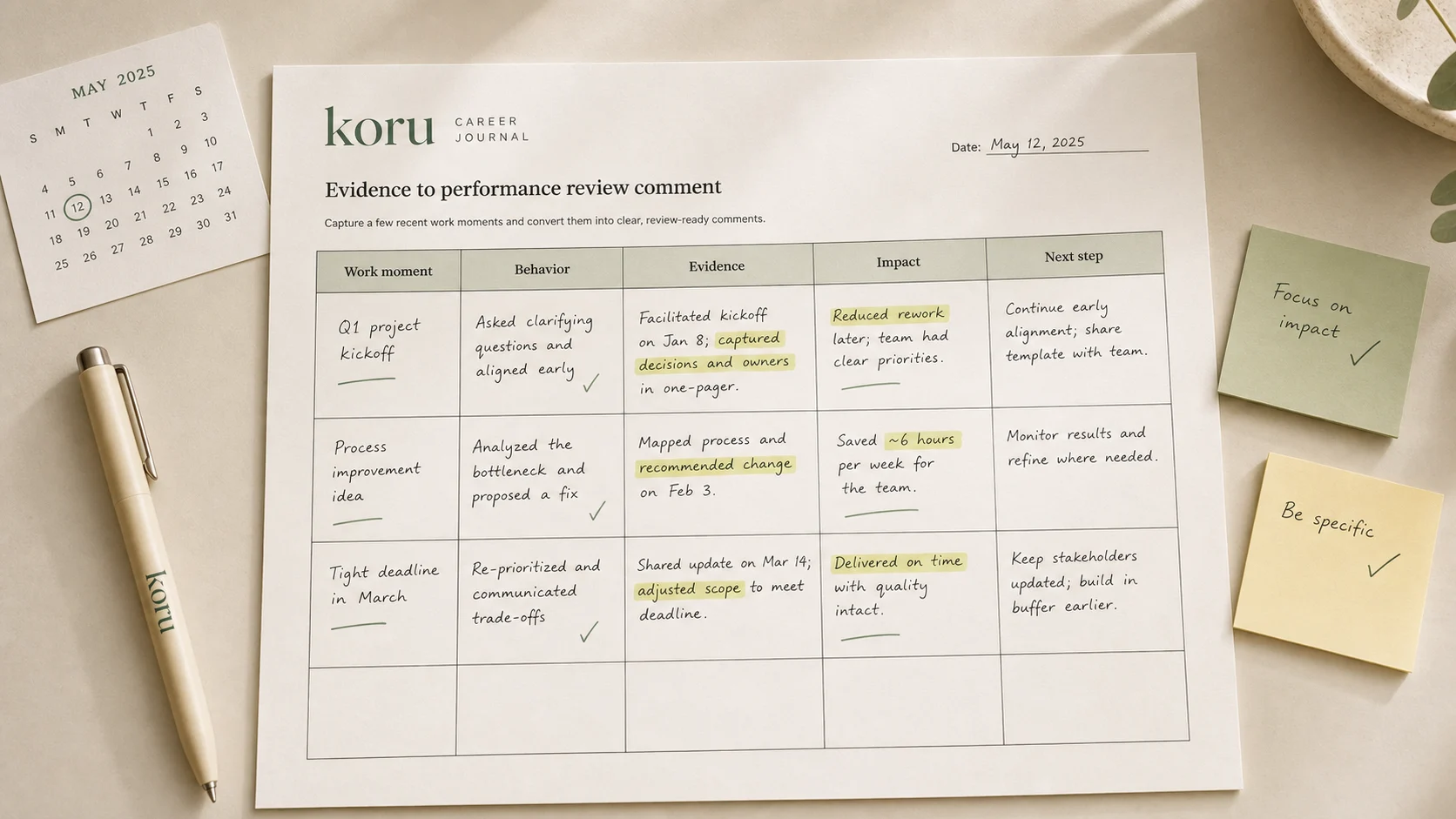
Use the worksheet before writing the comment. It keeps the sentence tied to the work moment, the behavior, the evidence, the impact, and the next step.
Performance review comments examples you can adapt
Use these examples as shapes, not scripts. Replace the bracketed details with the real work, date, stakeholder, customer issue, project, metric, or decision.
| Review area | Generic comment | Stronger comment |
|---|---|---|
| Delivery | "You consistently deliver strong work." | "You delivered [project] by [date] while coordinating [teams]. The useful part was how you kept the deadline visible when [constraint] changed." |
| Communication | "You communicate well." | "During [project], your weekly notes separated decisions, risks, and open questions. That helped [team] respond before the deadline moved." |
| Collaboration | "You are a great team player." | "You helped [team] resolve [problem] by owning [specific part] and making the handoff clearer for [stakeholders]." |
| Ownership | "You took ownership this cycle." | "When [area] had no clear owner, you mapped the current process, named the missing decision, and got agreement from [people/teams]." |
| Quality | "Your work is high quality." | "After [issue], you changed [review/check/process]. The next version caught [risk] before it reached [customer/team/workflow]." |
| Growth | "You have shown improvement." | "Compared with the last review cycle, you now [specific behavior]. The clearest example is [moment], where you [action] instead of [old pattern]." |
The stronger comments are still plain. That is the point. They do not try to sound polished before they are specific.
Positive comments that do not sound inflated
Positive comments often become vague because the writer is trying to be kind. Kindness is fine. Inflation is not.
Too broad
"You are an excellent collaborator who always helps the team succeed."
Evidence-based
"In the Q2 reporting cleanup, you worked with Finance and Operations to remove duplicate fields from the handoff. The result was one source file both teams could use for the review deck."
Here are more positive review comments you can adapt:
For initiative
"You did not wait for the next planning meeting to name the problem. You wrote the first draft of the process map, used it to find the missing owner, and brought a clearer recommendation to the team."
For reliability
"When the timeline changed, you updated the plan within the same day and made the tradeoffs visible. That gave the team enough time to choose what to cut instead of pretending the scope was unchanged."
For customer focus
"You turned repeated customer questions about [topic] into a short internal note. Support reused it during the next rollout, which made the answer more consistent."
For leadership without title
"You helped the group make progress before there was a formal owner. You clarified the open decision, asked the right people for input, and kept the next step visible."
Constructive comments that stay fair
The safest structure is:
| Part | What to write |
|---|---|
| Situation | "In [specific project, meeting, cycle, or deadline]..." |
| Behavior | "You [observable action or missed action]..." |
| Impact | "This affected [timeline, clarity, stakeholder, quality, risk]..." |
| Next step | "Next time, I want you to [specific behavior] by [when/how]." |
Too vague
"You need to be more proactive."
Fairer
"In the partner launch, two dependency risks were still unnamed the week before release. For the next milestone, I want you to identify owners and escalation dates during week one."
Too personal
"You seemed disengaged in cross-functional meetings."
Observable
"In the last three launch syncs, you did not share an update on the support handoff unless asked. For the next cycle, come prepared with status, risk, and one decision you need from the group."
The better versions may still be uncomfortable. They are also easier to act on.
Weak-to-strong rewrites for common review comments
If you only have a generic phrase, do not throw it away. Use it as a label, then find the evidence underneath.
| If you wrote this | Ask this | Rewrite it like this |
|---|---|---|
| "Great communication" | What message, meeting, or decision became clearer? | "Your weekly launch note made decisions, risks, and owners clear enough that the team could act without a second status meeting." |
| "Strong ownership" | What did they own that could have stayed vague? | "You took over the onboarding checklist after two handoffs exposed the same missing step, then got sign-off from Support and Legal." |
| "Needs better prioritization" | What tradeoff was missed or delayed? | "During sprint planning, too many lower-impact requests stayed in scope. Next cycle, I want to see the top three tradeoffs named before work starts." |
| "Good problem solver" | What problem did they diagnose or simplify? | "When the reporting numbers did not match, you traced the issue to two source files and proposed one owner-approved version for the review deck." |
| "Should improve stakeholder management" | Which stakeholder was surprised, blocked, or left without context? | "Product heard about the timeline risk after the customer update had already been drafted. Next time, share the risk note before external messaging." |
A worksheet for writing better comments
Before you write the final comment, fill in this small worksheet. If you cannot fill it in, the comment probably needs more evidence.
| Prompt | Notes |
|---|---|
| What happened? | Project, review period, customer issue, deadline, launch, meeting, incident |
| What did the person do? | Decision, analysis, handoff, escalation, draft, facilitation, follow-up |
| What changed because of it? | Time saved, risk reduced, fewer repeated questions, clearer ownership, better quality |
| Who saw or used the work? | Team, customer, manager, cross-functional partner, new hire, leadership group |
| What should happen next? | Repeat it, scale it, adjust it, document it, ask for support, set a new goal |
If you have to write comments today
If the review is due soon, do not try to remember the whole year from scratch. Use a short reconstruction pass.
- 01
Find three work moments
Pick one clear win, one collaboration moment, and one growth area. Use your calendar, project tool, docs, messages, or tickets.
- 02
Add one piece of evidence
For each moment, add a date, stakeholder, before/after detail, artifact, metric, or decision. One concrete detail is better than five adjectives.
- 03
Write the comment in one sentence
Use situation + behavior + evidence + next step. If the sentence gets too long, cut the praise first, not the evidence.
How Koru changes the next review
The hard part of writing performance review comments is rarely grammar. It is missing raw material.
A review-ready comment might start as a Friday note:
Beta launch risk note landed well. Product replied with the missing sign-off owner, Support added the customer-facing question we had missed, and Sales stopped asking for a separate status summary. Next time, add the external messaging owner earlier.
Later, that becomes:
"During the beta launch, you sent risk notes that gave Product, Support, and Sales one shared view of decisions and owners. For the next launch, keep that rhythm and add the external messaging owner earlier."
That is Koru's angle: the best comments are written from evidence you captured before you needed to sound impressive. A weekly note does not need to be polished. It needs to preserve the details that memory drops first.
Related reading
Comparison
Notion Career Journal Template vs Koru
Compare a Notion career journal template with Koru for career tracking, brag documents, STAR stories, and interview preparation.
Comparison
Koru vs Spreadsheets for Career Tracking
Compare Koru with Google Sheets and Excel for tracking career achievements. Learn why free spreadsheets often fail for career journaling and what makes purpose-built tools stick.
Career Development
Best Career Journal Apps in 2026
Compare the top career journaling apps for tracking achievements, preparing for interviews, and building your professional narrative. Tested and reviewed by career development experts.
Professional Development
Best Achievement Tracking Tools in 2026
Compare the best tools for tracking work accomplishments, building brag documents, and preparing for performance reviews. Reviews include AI-powered trackers and traditional methods.