 Koru
Koru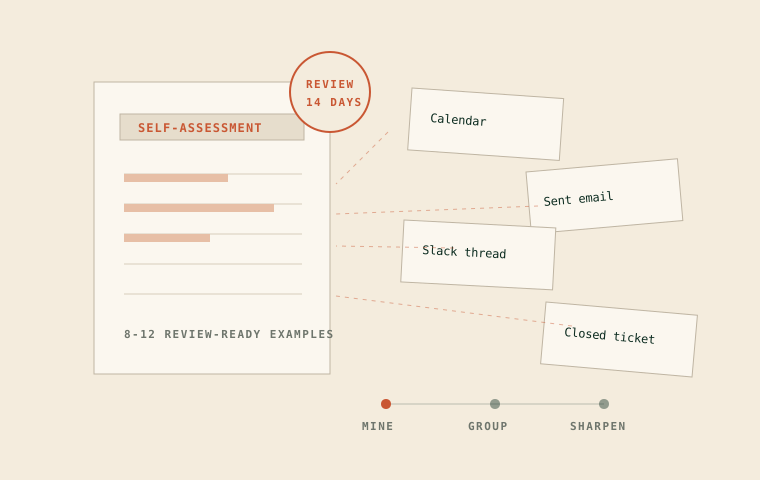
How to Prepare for a Performance Review When You Haven't Tracked Anything
Your review is in two weeks and you have nothing written down. That's normal. Here's a 2-hour reconstruction process that turns your calendar, email, and Slack history into a solid self-assessment.
Your performance review is in two weeks. You open the self-assessment form and stare at it. There's a field that says "Key accomplishments this period." You remember maybe three things, two of which happened last month. March is a blank. June is a blank. Most of the year is a blank.
You didn't track anything. You knew you should have. You didn't. That's fine. You're not alone -- most people don't track. The review is happening regardless, so let's work with what you have.
The 2-hour reconstruction worksheet
Use one timer. Do not wander through every tool.
| Time | Source | What to pull |
|---|---|---|
| 0-20 min | Calendar | Launches, reviews, planning meetings, QBRs, offsites |
| 20-45 min | Updates you sent, decisions, approvals, customer notes | |
| 45-70 min | Slack / Teams | Praise, escalations, incident threads, shipped announcements |
| 70-95 min | Tickets / docs | Closed work, specs, pull requests, project plans |
| 95-120 min | Draft | Group evidence into 3-5 themes and write the self-review |
Search terms: launched, shipped, resolved, fixed, reduced, saved, approved, blocked, escalated, summary, update, decision, customer, renewal, review.
What it feels like
"March is blank. June is blank. I know I did things, but I can't find them fast enough."
What your tools remember
"Calendar, sent email, Slack, tickets, 1:1 notes. The year is fragmented, not gone."
The reconstruction toolkit
You don't remember what you did, but your tools do. Each of these sources contains fragments of your year. The goal is to mine them systematically, not randomly.
Calendar
Memory triggers: QBRs, offsites, recurring commitments, one-off milestones.
Sent email
Search for update, results, shipped, launched, completed, summary.
Slack / Teams
Threads, reactions, and channel updates place you at specific moments.
Project tools
Jira, Asana, Linear, Trello: filter completed work by owner and date.
1:1 notes
Shared notes often contain achievements you did not think were noteworthy.
Last year's review
Old goals reveal progress you stopped thinking about months ago.
Source checklist
Before writing the final review, check:
- Calendar meetings with executives, customers, managers, or project teams.
- Sent email updates and decision notes.
- Slack or Teams threads where you explained, unblocked, or summarized work.
- Tickets assigned to you and tickets where you made the key decision.
- Docs, decks, pull requests, dashboards, or planning artifacts.
- Prior goals and last year's review.
- Manager 1:1 notes and feedback snippets.
Sample self-review paragraph
"This cycle I focused on making onboarding more predictable for new customers and for the internal teams supporting them. The clearest result was the handoff cleanup in Q2: I consolidated three intake docs into one checklist, clarified ownership with support and implementation, and reduced repeated setup questions in the team channel. I also handled two escalations where missing context between sales and support had created customer frustration. In both cases, I rebuilt the timeline, got the right owner in the room, and turned the fix into a reusable note for the next handoff. Next cycle I want to make this less reactive by reviewing the first 30 days of every new account and tracking patterns before they become escalations."
The 2-hour reconstruction sprint
You don't need a weekend. You need two focused hours and a blank document. Here's the process:
Mine your sources (60 min)
Open your calendar, sent email, Slack, and project tool side by side. Go month by month from the start of the review period. Write down everything you find -- no filtering, no judging, no polishing. Aim for 15-20 raw items. Even if they seem small. Especially if they seem small, because small things add up and you're not a reliable judge of significance right now.
Group into themes (30 min)
Look at your list of 15-20 items. Patterns will emerge. Group them into categories that make sense for your role. Common ones: projects delivered, skills developed, problems solved, team contributions, goals achieved, scope expanded.
Sharpen your top examples (30 min)
For each theme, pick the 2-3 strongest items. Add specifics: numbers, timelines, names, outcomes. If you don't have exact figures, use honest approximations ("reduced by roughly 30%" is better than "significantly improved").
The output is a one-page document with 8-12 specific achievements organized by theme. That's more than enough for a solid self-assessment.
0:00-1:00
Mine
Pull 15-20 raw items from calendar, messages, email, and tickets.
1:00-1:30
Group
Cluster into themes: delivered, solved, mentored, expanded, improved.
1:30-2:00
Sharpen
Add numbers, scope, timelines, names, constraints, and outcomes.
Turning raw memories into review-ready statements
The items you mined from your tools will sound like this: "did that migration thing in Q2." That's fine for your raw list. It's not fine for your self-assessment.
Here's the transformation:
Raw memory
"Did that migration thing in Q2"
Add
Action + scope + outcome
Review-ready
"Led database migration affecting 50K user records, completed 2 weeks ahead of schedule with zero data loss."
"Helped with onboarding" -> "Designed and ran onboarding for 4 new team members, reducing ramp-up from 6 weeks to 3."
"Dealt with angry client" -> "Retained at-risk enterprise account worth EUR 120K ARR with root-cause fix and weekly cadence."
"Ran workshops" -> "Facilitated 6 workshops, training 35 people across 4 departments in 3 weeks."
"Reporting mess" -> "Cut monthly reporting from 3 days of manual work to 4 automated hours."
The pattern is consistent: start with the action, add the scope, include the outcome. Numbers make it concrete. Context makes it meaningful.
Common traps during reconstruction
The "never again" paragraph
You just spent two hours reconstructing a year from digital breadcrumbs. Some of it was surprisingly effective -- you found things you'd forgotten, and the self-assessment came together. But you also know that you lost details. The numbers you couldn't find. The context that's gone. The projects where you remember the outcome but not what made it hard.
The bar is low. The payoff is not.
Related reading
Comparison
Notion Career Journal Template vs Koru
Compare a Notion career journal template with Koru for career tracking, brag documents, STAR stories, and interview preparation.
Comparison
Koru vs Spreadsheets for Career Tracking
Compare Koru with Google Sheets and Excel for tracking career achievements. Learn why free spreadsheets often fail for career journaling and what makes purpose-built tools stick.
Career Development
Best Career Journal Apps in 2026
Compare the top career journaling apps for tracking achievements, preparing for interviews, and building your professional narrative. Tested and reviewed by career development experts.
Professional Development
Best Achievement Tracking Tools in 2026
Compare the best tools for tracking work accomplishments, building brag documents, and preparing for performance reviews. Reviews include AI-powered trackers and traditional methods.