 Koru
Koru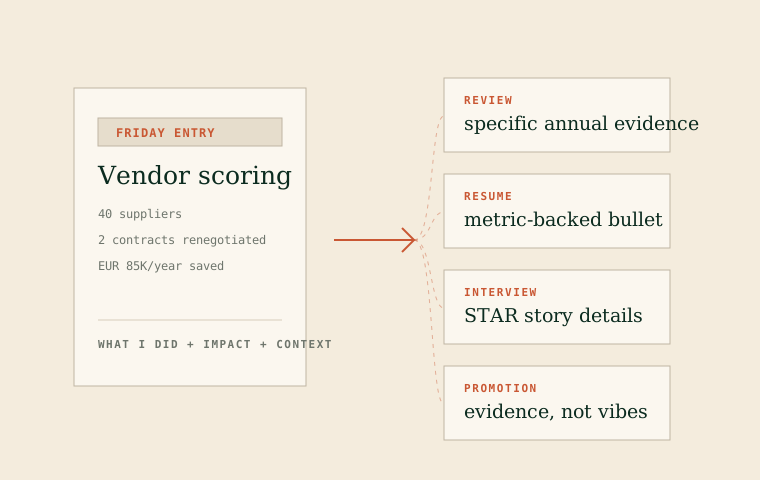
How to Write a Brag Document (and Actually Use It)
A brag document is the simplest career habit that works: a running list of what you did and why it mattered. Most people start one and quit in three weeks. Here's how to not be most people.
A brag document is a running list of things you did at work that you'd want to cite later. The name comes from the tech world, but the practice is useful for anyone who has ever sat in a performance review and thought, "I know I did more than this."
Brag document template
Copy this near the top of your document so the next entry is easy to write.
Date:
Project / area:

What happened:

What I did:

Why it mattered:

Evidence:

- Metric:
- Stakeholder:
- Link:

Where I might reuse this:

- Performance review:
- Resume / CV:
- Interview story:
Six months later
"I think I did something with vendor contracts? We saved some money. Not sure how much."
Friday note
"Vendor scoring redesign. 40 suppliers. 2 contracts renegotiated. EUR 85K/year saved. Finance adopted the framework."
When it happens
“Led vendor scoring redesign for 40 suppliers. Renegotiated 2 contracts using the data — saved EUR 85K/year. Finance adopted the framework org-wide.”
6 months later
“I think I did something with vendor contracts? We saved some money. Not sure how much.”
The concept has been around for years. Julia Evans wrote about it. It gets shared on Reddit and HackerNews every few months. Plenty of people have started one.
Almost nobody keeps it going past three weeks.
3
weeks
Most brag documents do not fail because the format is bad. They fail when the Friday rhythm breaks and the blank gap starts feeling too large to repair.
Start
Miss one Friday
Abandon
What a brag document entry looks like
Each entry is a few fields. Date, what you did, impact, and enough context to jog your memory six months from now.
Mar 2026 · Engineering manager
Redesigned onboarding flow. Activation rate went from 23% to 41% over six months. Worked with 3 engineers and a product designer. VP sponsored the initiative.
Jan 2026 · Operations lead
Built vendor scoring system for top 40 suppliers. Renegotiated two contracts using the data, saving EUR 85K annually. Finance adopted the framework.
Feb 2026 · Marketing coordinator
Ran first partner webinar series. 3 sessions, 1,200 registrations, 34% attendance. Pipeline sourced from attendees: EUR 220K.
Mar 2026 · HR business partner
Designed manager feedback training after survey score of 3.1/5. Ran 6 sessions. Follow-up pulse: 4.0/5. Attrition dropped 12%.
Notice the pattern. Short. Factual. Specific numbers where they exist. Enough context that you'll remember the story, but not so much that writing the entry takes more than two minutes.
Why most brag documents die
The typical lifecycle looks like this:
Week 1
Four entries. Productive energy.
Week 2-3
Missed Friday. Monday slips.
Week 4-6
The gap starts feeling like failure.
Week 7+
Abandoned tab. Start fresh next quarter.
There are two failure modes here, and they usually work together.
Overwriting
The entry becomes a mini-essay. Fifteen minutes of phrasing turns a weekly habit into homework.
No trigger
Without a recurring Friday reminder, the system depends on motivation. Motivation expires fast.
The fix is boring (and that's the point)
One recurring calendar reminder. Friday at 4pm works for most people: the week is still fresh, you're winding down, and it takes less time than making coffee.
Three fields per entry: what you did, impact, context. No editing for quality. No going back to polish old entries. If the entry takes more than two minutes, you're overwriting.
What I did
One sentence. What happened this week that you'd want to cite later.
Impact
Numbers if you have them. "Reduced X by Y" or "Shipped Z to N users." If no numbers yet, describe the outcome in plain language.
Context
Who was involved, what constraints existed, why this mattered. One or two sentences.
After a month, you'll have four entries. After three months, twelve. After a year, fifty. None of them took more than two minutes.
What to do with it
This is where most brag document guides stop. "You'll have it for your review!" Great. But a list of raw entries isn't useful on its own. It needs to become something.
Here's the progression. Same achievement, four different outputs:
Raw brag doc entry
Redesigned onboarding flow. Activation went from 23% to 41% over 6 months. 3 engineers + product designer. VP sponsored.
Resume bullet
Led cross-functional redesign of user onboarding, increasing activation rate from 23% to 41% within 6 months.
STAR interview story
Situation: activation was stuck at 23%, and the VP of Product flagged it as a company priority. Task: redesign the onboarding experience without disrupting the existing user base. Action: assembled a 4-person team, ran a 2-week discovery sprint, shipped iterative changes over 3 months. Result: activation hit 41% at the 6-month mark. The framework we built became the template for all new feature launches.
Review evidence
This became one of the clearest examples of cross-functional leadership, measurable impact, and product judgment from the review period.
The raw entry took two minutes to write. The resume bullet took thirty seconds to derive from it. The STAR story took five minutes because all the details were already there.
Raw note
23% -> 41%, onboarding, 4-person team
Resume
metric-backed bullet
Interview
STAR story with real details
Review
evidence of scope and impact
After three months of entries, the raw material starts compounding:
Interviews
Resumes
Write bullets with real numbers instead of vague claims.
Reviews and promotions
Walk in with examples from every quarter and a promotion case grounded in evidence.
Patterns and confidence
Spot what kind of work you gravitate toward and stop second-guessing your impact.
Brag document vs. career journal
Brag document
A list of what you did and why it mattered. Wins, impact, numbers. The evidence you need for reviews and resumes.
Career journal
Everything a brag doc captures, plus: challenges you navigated, decisions you made, feedback you received, things you learned. The context that makes the wins meaningful.
If a brag document in a spreadsheet is working for you, keep going. The habit matters more than the tool.
Either way, the starting point is the same. Open a document. Write down one thing you did this week that mattered. Do it again next Friday.
Examples by role
Engineer: "Reworked the retry path for payment webhooks after two customer-impacting failures. Error rate dropped from 1.8% to 0.2% over the next release cycle."
Product manager: "Cut two low-confidence onboarding features from the launch scope and moved the team toward the activation step with the strongest support-ticket evidence."
Marketer: "Rebuilt the webinar follow-up sequence around three audience segments. Reply quality improved, and sales reused the copy for outbound."
Manager: "Changed weekly planning from status updates to blocker review. Two quieter team members started raising risks earlier, which helped us catch a release dependency before it slipped."
FAQ
How long should a brag document be?
Long enough to contain the evidence. A good document may be messy during the year and tighter before a review. Do not edit too early; capture first, shape later.
Should I include small wins?
Yes, if they show judgment, consistency, or useful impact. Small entries often become patterns when you review several months at once.
Is a brag document private?
Usually, yes. Treat it as your working file. Share selected examples with a manager, recruiter, or interviewer only when they are relevant.
How is this different from a career journal?
Related reading
Comparison
Notion Career Journal Template vs Koru
Compare a Notion career journal template with Koru for career tracking, brag documents, STAR stories, and interview preparation.
Comparison
Koru vs Spreadsheets for Career Tracking
Compare Koru with Google Sheets and Excel for tracking career achievements. Learn why free spreadsheets often fail for career journaling and what makes purpose-built tools stick.
Career Development
Best Career Journal Apps in 2026
Compare the top career journaling apps for tracking achievements, preparing for interviews, and building your professional narrative. Tested and reviewed by career development experts.
Professional Development
Best Achievement Tracking Tools in 2026
Compare the best tools for tracking work accomplishments, building brag documents, and preparing for performance reviews. Reviews include AI-powered trackers and traditional methods.