 Koru
Koru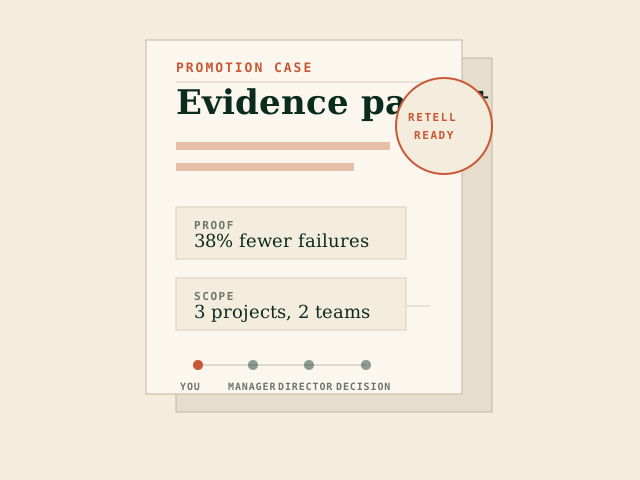
How to ask for a promotion with evidence, not just confidence
Most promotion advice focuses on timing and confidence. The actual problem is building a case your manager can take upstairs. Here's how to construct one with specifics, not feelings.
You want a promotion. Your manager probably thinks you deserve one. So why hasn't it happened?
Because your manager is not the last stop. Promotions go through a chain: your manager pitches you to their manager, who takes it to HR or a compensation committee. Each step filters out anything that sounds like opinion and keeps anything that looks like evidence. "She's really good" doesn't survive that chain. "She led the platform migration that reduced downtime by 70%, grew the team from 3 to 6, and owns the relationship with our largest account" does.
The problem isn't confidence. It's documentation.
Opinion
"I've been doing a great job, taking on more responsibility, and I feel ready for the next level."
Evidence
"I now own 3 projects across 2 teams, present monthly to the VP, and led the payments migration that reduced failed transactions by 38%."
Why "I deserve it" doesn't work
Your manager agrees you're good. That's not the bottleneck. The bottleneck is that they need to convince people who have never worked with you, in a meeting where they're also advocating for other people on their team.
- 01
You make the case
This is the easy part. Your manager sees your work daily. They're probably already on your side. But being on your side and being able to articulate your case are different things.
- 02
Manager retells it
Now your work is being described secondhand. Your manager needs specific examples, numbers, and scope to make this work. Without them, they're stuck with "she's been doing a great job," which sounds like every other pitch in the room.
- 03
Committee compares it
People in this room have a budget and a list of candidates. They're comparing across teams. The candidates with concrete evidence win. The ones described in generalities get pushed to next cycle.
Feelings get filtered out at every step. Specifics survive.
The three things a promotion case needs
Not five. Not ten. Three.
- 01
Scope increase
Evidence that you're already operating at the next level, not just doing your current job well. If you were managing 2 projects a year ago and now you're managing 5 across two teams, that's scope increase. If you were an individual contributor and now junior engineers come to you for technical decisions, that's scope increase. The question is: has the boundary of your role expanded?
- 02
Measurable impact
Numbers. Revenue influenced, costs reduced, time saved, people managed, projects delivered. If your role doesn't have obvious revenue metrics, there are still numbers. Deployment frequency, bug reduction rates, customer satisfaction scores, hours saved per sprint. See how to quantify achievements when you don't have numbers for roles where metrics aren't obvious. - 03
Repeatability
One big win could be luck. A pattern of impact over 6-12 months shows it's you, not the situation. This is where a timeline of achievements matters. A string of wins across multiple quarters is more convincing than a single hero moment, because it demonstrates consistency.
Scope: then vs now
The most persuasive part of a promotion case is often the simplest. Show what your role looked like 12 months ago next to what it looks like now.
Your role 12 months ago
- Managed 1 project with 3 direct reports
- Reported to engineering lead on sprint progress
- Owned frontend implementation for the dashboard
- Participated in quarterly planning
Your role today
- Managing 3 concurrent projects across 2 teams, 6 direct reports
- Presenting progress directly to VP of Product in monthly reviews
- Owning technical architecture decisions for the entire customer-facing platform
- Leading quarterly planning sessions and setting team OKRs
If the gap between the two columns is large, you have a scope argument. If they look the same, you may be doing your current job very well, which is worth recognizing, but it's a different conversation than a promotion.
Building the one-page case
Your promotion case should fit on one page. Not because anyone will literally print it, but because the constraint forces you to prioritize. Here's the structure:
Current level
Senior Product Manager.
Next-level scope
Leading cross-functional planning for the payments team (12 engineers, 3 designers). Owning the relationship with our two largest enterprise clients. Running the quarterly roadmap review with the VP. Moved from owning a single product surface (checkout flow) to owning the full payments platform across web and mobile.
Evidence
- Led payments v2 migration across 3 markets. Reduced failed transactions by 38%, adding approx. EUR 400K in recovered annual revenue
- Built and onboarded 5 new team members during H2. Team velocity increased 25% by Q4 despite the ramp-up period
- Identified and fixed a billing discrepancy affecting enterprise clients. Retained 2 at-risk accounts worth combined EUR 650K ARR
- Proposed and implemented the async standup format now used across 4 teams. Reduced meeting time by 6 hours per week for the engineering org
Stakeholder quotes
"The payments migration was the smoothest cross-market launch we've done." VP Engineering, October all-hands.
"She's the reason we didn't lose [client name]." Head of Sales, Q3 review.
Next-level plan
Formalize the cross-team planning process I've been running informally. Take ownership of the enterprise partnership strategy alongside Sales. Mentor the two senior PMs who are trending toward leadership roles.
Notice: the achievements are specific, numbered, and tied to outcomes. The next-level plan shows forward thinking, not just a request for a title bump.
60-second version
She is already operating at the next level. Over the last two quarters, she moved from owning checkout improvements to leading the full payments platform across web and mobile.
Proof to repeat
- Payments v2 reduced failed transactions by 38%
- Enterprise billing fix helped retain EUR 650K ARR
- Async standup format is now used across 4 teams
Decision ask
Promote her into the role that matches the scope she is already carrying, and formalize the cross-team planning ownership she has been doing informally.
The conversation itself
The document does the heavy lifting. The conversation is you walking your manager through it.
Don't open with "I want a promotion." Open with the document. Share it a few days before the meeting so your manager has time to read it and think. In the meeting, walk through the highlights. Then ask:
"What would need to be true for this to happen in the next cycle?"
That question is better than "I want a promotion" for a specific reason: it turns your manager into an ally. Instead of responding to a request (which puts them on the spot), they're telling you what's missing. Maybe nothing is missing and the answer is "I'll push for it." Maybe they tell you the one thing the committee will ask about. Either way, you're working together instead of negotiating.
The documentation shortcut
If you've been keeping a career journal or tracking achievements throughout the year, the promotion document writes itself. You're selecting from existing entries, sorting by impact, and formatting. That's a 30-minute exercise.
The difference between "I improved the process" and "I reduced report generation from 3 days to 4 hours, and the CFO now uses the output in board presentations" is the difference between a case that gets deferred and one that gets approved.
Build the case first. The confidence follows.
Related reading
Comparison
Notion Career Journal Template vs Koru
Compare a Notion career journal template with Koru for career tracking, brag documents, STAR stories, and interview preparation.
Comparison
Koru vs Spreadsheets for Career Tracking
Compare Koru with Google Sheets and Excel for tracking career achievements. Learn why free spreadsheets often fail for career journaling and what makes purpose-built tools stick.
Career Development
Best Career Journal Apps in 2026
Compare the top career journaling apps for tracking achievements, preparing for interviews, and building your professional narrative. Tested and reviewed by career development experts.
Professional Development
Best Achievement Tracking Tools in 2026
Compare the best tools for tracking work accomplishments, building brag documents, and preparing for performance reviews. Reviews include AI-powered trackers and traditional methods.