 Koru
Koru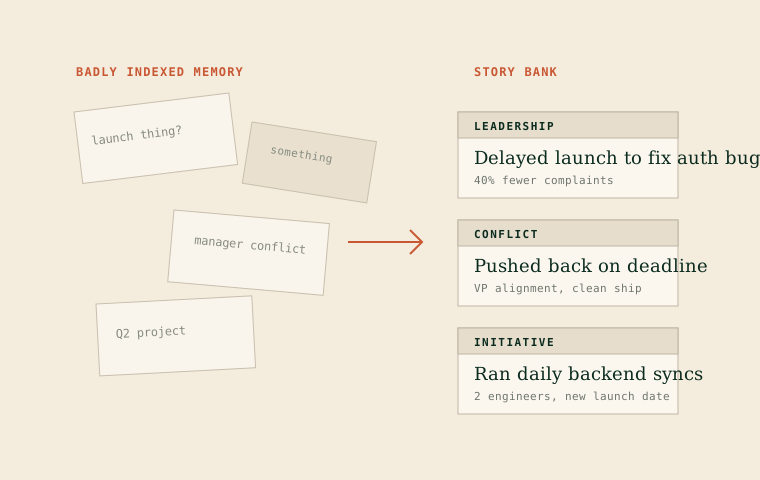
Why you can't talk about yourself in interviews (and what to do about it)
The blank-mind problem in interviews isn't about confidence. It's a retrieval failure -- your brain stores career memories but indexes them badly. Here's how to fix that with a system instead of a pep talk.
You know the moment. The interviewer leans forward and says "tell me about a time you showed leadership." Your mind goes blank. Not because you've never led anything. You led a team through a product launch six months ago. You stepped up during a reorg last year. You know this.
But right now, under pressure, with someone watching you think, you can't access any of it.
Blank mind
"Leadership? I know I have something. There was a launch... or a reorg... wait, what was the question again?"
Indexed memory
"Launch delay. VP pushback. Auth bug. Two backend engineers. Daily syncs. Shipped clean. Complaints dropped 40%."
This is not a confidence problem
Most interview advice treats the blank-mind moment as a psychological issue. Practice your elevator pitch. Believe in yourself. Project confidence. As if the problem is that you don't think you're good enough.
That's the wrong diagnosis. The problem is retrieval. Your brain has stored thousands of work memories across years of your career, but it indexes them terribly. You can remember what you had for lunch yesterday, but not the project you rescued in Q2.
This isn't a character flaw. It's how human memory works.
What sticks
- Embarrassing moments from 2019
- Anything from the last two weeks
- Dramatic failures
- What other people did wrong
- The lunch you had yesterday
What fades
- Quiet wins from last quarter
- Anything older than three months
- Steady, competent work
- What you did right
- The project you shipped in March
Novel and emotional events stick. Routine competence, even exceptional routine competence, fades. So when someone asks you to recall a leadership moment on demand, your brain serves up nothing because "led a cross-functional team to ship on time" didn't register as memorable when it happened. It was just Tuesday.
When it happens
“Convinced the VP to delay launch by two weeks so we could fix the auth bug. Pulled in two backend engineers, ran daily syncs, shipped clean on the new date. Customer complaints dropped 40%.”
Interview day (6 months later)
“I think there was a thing with a launch delay? Something about a bug. It went fine, I think.”
Why "just prepare 5 stories" doesn't work
The standard STAR prep advice is to prepare five stories covering common themes: leadership, conflict, failure, teamwork, initiative. Rehearse them. Walk in ready.
The problem: interviewers don't ask the five questions you prepped for. They ask adjacent questions, follow-up questions, questions from weird angles. "Tell me about a time you disagreed with data" is not the same as "tell me about a time you handled conflict," even though they're close.
5 rehearsed stories
You walk in with five polished answers. Question six doesn't match any of them. You either shoehorn an irrelevant story or freeze. The interviewer notices both.
20 raw moments
You walk in with twenty tagged memories. Any question triggers 2-3 relevant options. You pick the best fit and tell it with real detail because the details are captured, not reconstructed.
Question
"Tell me about disagreement."
Tags
conflict, initiative, constraints
Story
pick the moment with the clearest stakes and outcome
The real fix: a retrieval system
The people who are good at talking about themselves in interviews aren't more confident or more articulate. They have better access to their own history. They can scan their memory (or their notes) and pull a relevant moment in seconds.
This is what a story bank does. It's what a career journal produces over time.
Here's how it works in practice. Someone with a 15-entry story bank tagged by theme gets asked "tell me about a time you disagreed with your manager." They scan their tags, find entries under "conflict" and "initiative," pick the best fit, and tell it with real detail -- names, numbers, constraints, outcomes -- because those details were captured when they were fresh.
Tag your moments
Each moment gets 1-2 theme tags: leadership, conflict, initiative, technical problem, collaboration, working under constraints, learning from failure.
Hear the question
"Tell me about a time you disagreed with your manager."
Scan your tags
Conflict. Initiative. Maybe working under constraints. Three moments fit. Pick the one with the best specifics.
Tell it with real detail
The details are already captured. You're narrating a memory, not constructing a story on the spot.
The difference between this and rehearsing scripts is flexibility. Scripts break when the question changes. A tagged bank of real moments adapts to anything.
Leadership
Delayed launch by two weeks to fix auth bug. Pulled in backend support. Complaints dropped 40%.
Conflict
Disagreed with manager on timeline, brought incident data, aligned on safer launch plan.
Initiative
Started daily syncs without being asked because the handoff risk was increasing.
Constraints
Two engineers, fixed launch date pressure, VP expectation, customer complaints rising.
Build retrieval in 30 minutes
If you have an interview coming soon and haven't been tracking anything, you can build a basic story bank in a single sitting.
Open your calendar from the last 12 months. For each month, write down one thing that happened. Don't filter. Don't polish. Just capture the event.
Month by month. Scroll through your calendar. For each month, write one work event that comes to mind. Don't overthink it.
- Jan: Onboarded three new hires while short-staffed
- Feb: Pushed back on a deadline that wasn't realistic
- Mar: Shipped the pricing page redesign
- Apr: Ran the first cross-team retro
- May: Covered for a colleague on parental leave
- Jun: Flagged a data issue before it hit production...
Then tag each one. Leadership, conflict, initiative, collaboration, technical, failure, stakeholder management. Most moments cover 2-3 tags.
After 12 months, you have 12 raw moments. Tag each with 1-2 themes. That's a basic story bank. It's not as rich as one built over months of regular journaling, but it's infinitely better than walking into an interview with nothing.
The long-term version
The 30-minute sprint fixes the immediate panic. The long-term version is capturing moments weekly so you never have to reconstruct again.
Two minutes, Friday afternoon, three questions: what did I do this week that I'd want to cite later, what was hard, what did I learn. After 3 months you have 12 entries. After 6 months, 24. After a year, you have more material than you'll ever need for any interview.
The next time you blank in an interview, it won't be because you have nothing to say. It'll be because you haven't written it down yet. That part is fixable.
Related reading
Comparison
Koru vs Career Coaches: AI Tool vs Human Expertise
Compare Koru with hiring a career coach. Learn when AI-powered career tools complement coaching, and when human expertise is worth the investment. They're not mutually exclusive.
Comparison
Notion Career Journal Template vs Koru
Compare a Notion career journal template with Koru for career tracking, brag documents, STAR stories, and interview preparation.
Interview Preparation
Best Interview Prep Tools in 2026
Compare the top interview preparation tools for behavioral interviews, STAR stories, and company research. AI-powered prep, mock interview platforms, and question databases reviewed.