 Koru
Koru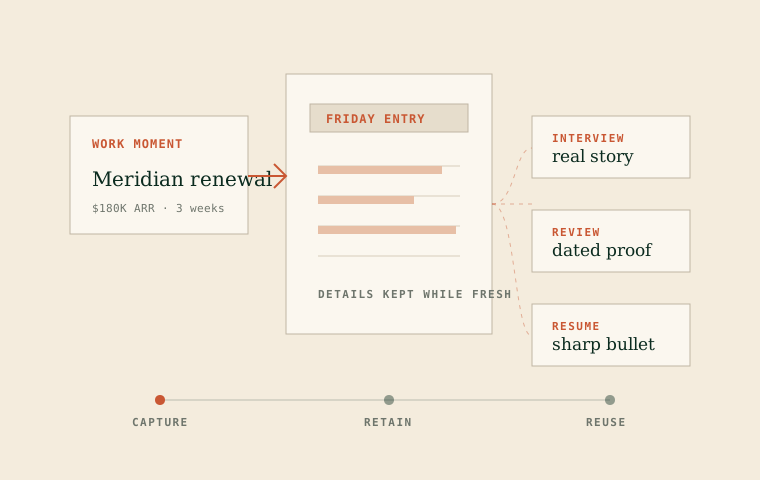
What is a career journal (and why most people don't start one until it's too late)
A career journal isn't a diary, a Notion template, or a feelings exercise. It's a structured habit of recording what you did while you still remember the details. Here's what it actually is and how to start.
You had a good quarter. You know you did. But when someone asks you to describe what made it good, you go blank. You remember being busy. The specifics are gone: the numbers, the decisions, the moments that actually mattered.
This happens to everyone. Not because the work wasn't significant, but because the human brain treats routine professional activity the same way it treats driving to the office: useful at the time, not worth storing permanently.
A career journal fixes this. Not by making you more reflective or self-aware. By giving you a record.
Good quarter
"Busy. Lots happened. I think the client renewal went well, and there was an outage we handled."
Career journal entry
"Meridian renewal: $180K ARR, up from $140K. API outage: 47 minutes, three affected clients, config rollback."
What a career journal actually is
A career journal is a regular practice of writing down work events that would be useful later. Achievements with numbers. Decisions you made and why. Problems you solved. Feedback you received. Skills you used in ways that surprised you.
It's not a narrative. It's not a reflection exercise. It's a factual record, written close enough to the event that the details are still accurate.
Weekly is enough. Some people do it daily, but for most professionals, a Friday afternoon entry covers what matters without becoming another obligation.
That took about four minutes to write. Six months from now, without this entry, the Meridian renewal becomes "I managed some account expansions" and the outage response disappears entirely.
Why the details vanish
Memory research is consistent on this point: you lose roughly two-thirds of new information within 24 hours, and routine professional work fades even faster because your brain doesn't flag it as novel.
Week it happens
“Led the API migration for 3 enterprise clients, reduced average response time from 340ms to 120ms, coordinated across backend and DevOps over 6 sprints”
6 months later
“I worked on some API stuff... it was a migration, I think? It went well.”
This is the gap that creates the scramble. Resume update? You're guessing. Performance review? You're winging it. Interview prep? You're constructing answers from fragments.
What a career journal is not
- Factual record: what happened
- Written close to the event: while details are fresh
- Captures hard moments: not only wins
- Raw material: useful later, not polished today
- Diary: how the week felt
- To-do list: what still needs doing
- Brag doc only: already-curated highlights
- Database project: structure before evidence
Who gets the most from this
The people who benefit most from career journaling tend to be 3-15 years into their careers. They have real accomplishments but struggle to articulate them on demand.
You know the type. Maybe you are the type. You're good at the work. You're bad at talking about the work.
Your work shows up in smoother launches, calmer clients, fewer escalations, or decisions other people now rely on.
You freeze on demand
In reviews and interviews, the work was real, but the numbers and constraints disappear under pressure.
Not for vanity. For accuracy: what changed, who was involved, and why the outcome mattered.
The project manager who saved a deal
Renegotiated scope with a client who was about to cancel a $400K engagement. Brought in the technical lead, restructured the timeline, personally managed weekly check-ins for two months. Client renewed and expanded the following year.
What they say in interviews 8 months later
"I managed client relationships and helped with retention."
That's not a skills problem. It's a documentation problem. The PM did the hard work. They just didn't write it down while the details were fresh.
How to start without overthinking it
Friday afternoon. Five minutes. One entry. Use the questions and fields together; the questions find the moment, the fields keep it useful.
What did I do this week that I'd want to remember?
Anything with a result, a number, or a decision. Shipped something. Fixed something. Convinced someone. Doesn't have to be impressive; it has to be specific.
Was there a hard moment I handled?
A conflict, a tight deadline, a problem without a clear solution. These make the best interview stories later, and they're the first things you forget.
Did anything change?
New responsibility. Shifted priorities. Feedback from someone senior. Recognition. A skill you used for the first time. Changes are easy to miss in the moment and impossible to reconstruct later.
That's it. Don't pick a tool yet. Don't build a template. Just answer those three questions for four weeks and see what accumulates. A notes app works. A text file works. The format doesn't matter until you've proven to yourself that you'll actually do it.
Where it leads
After a few months of entries, you have something most professionals never build: a searchable record of your own career with the details intact.
Raw material for STAR stories you can assemble on the fly, because you have real moments to draw from.
Bullet points with actual numbers and outcomes, not responsibilities copied from a job description.
Dated evidence of what you delivered, when, and what it produced.
Specific scope, outcomes, and constraints that make your case easier to retell.
Patterns in the work you keep solving, enjoying, avoiding, or getting recognized for.
The journal isn't the output. It's the raw material that makes every other career task easier, from salary negotiations to figuring out what kind of work you actually want to do next.
You don't need a system. You don't need an app. You need last Friday's details before they fade.
Related reading
Comparison
Notion Career Journal Template vs Koru
Compare a Notion career journal template with Koru for career tracking, brag documents, STAR stories, and interview preparation.
Career Development
Best Career Journal Apps in 2026
Compare the top career journaling apps for tracking achievements, preparing for interviews, and building your professional narrative. Tested and reviewed by career development experts.
Professional Development
Best Achievement Tracking Tools in 2026
Compare the best tools for tracking work accomplishments, building brag documents, and preparing for performance reviews. Reviews include AI-powered trackers and traditional methods.