 Koru
KoruAI Interview Coach Tools: How to Use Them Without Sounding Generic
AI interview coach tools can help with question practice, follow-ups, pacing, and feedback. They work best when you bring real work evidence first.
An AI interview coach is useful when you need practice, pressure, and feedback before a real interview. It can generate role-specific questions, run a mock interview, ask follow-ups, flag vague answers, and help you hear where you ramble.
It should not be the source of your answer.
The best workflow is evidence first, AI coach second. Write down the real work moment you want to use, including the constraint, your action, and the result. Then ask the AI coach to test the answer, probe for missing detail, and point out where you sound generic. If you start with "write me an answer for a product manager interview," you usually get something smooth enough to forget and generic enough to sound like everyone else.
This article is not a ranking of every AI interview coach. The useful question is simpler: what kind of interview problem are you trying to fix, and which tool behavior helps without taking over your voice?
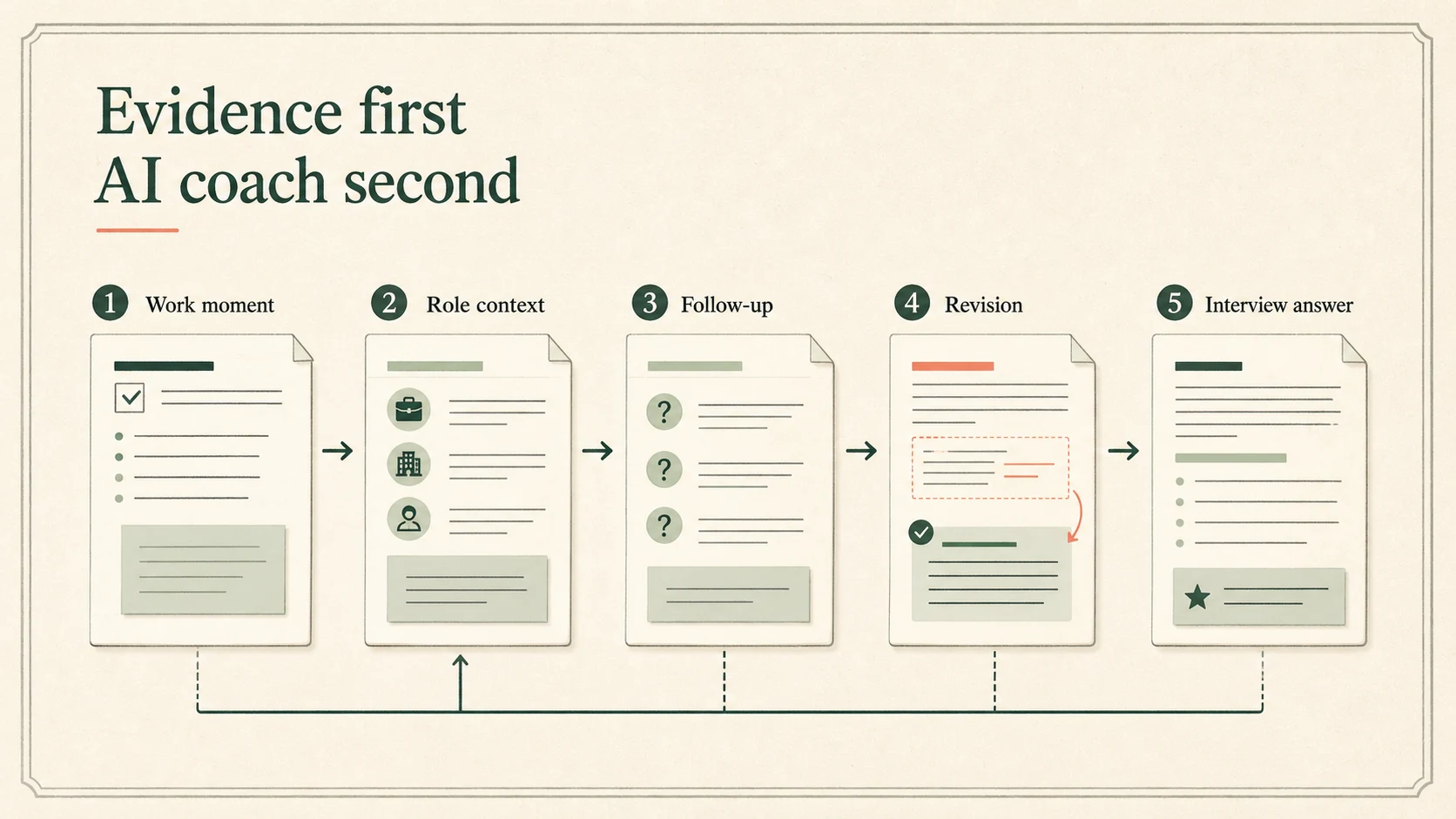
The coach should enter after the facts are on the page. Otherwise it has nothing real to test.
What AI interview coaches actually do
Most AI interview coach tools combine a few jobs:
- generating questions from a role, resume, or job description
- role-playing a mock interview
- asking follow-up questions
- scoring or critiquing answers
- giving feedback on speech, pacing, clarity, or non-verbal signals
- in some tools, offering live guidance during an actual interview
Those features are real enough. The risk is assuming they solve the whole interview. They do not. They can help you rehearse what you already know. They cannot responsibly invent what happened in your career.
Choose by the problem you have
Before you pay for a tool, name the failure mode. Otherwise every feature looks useful.
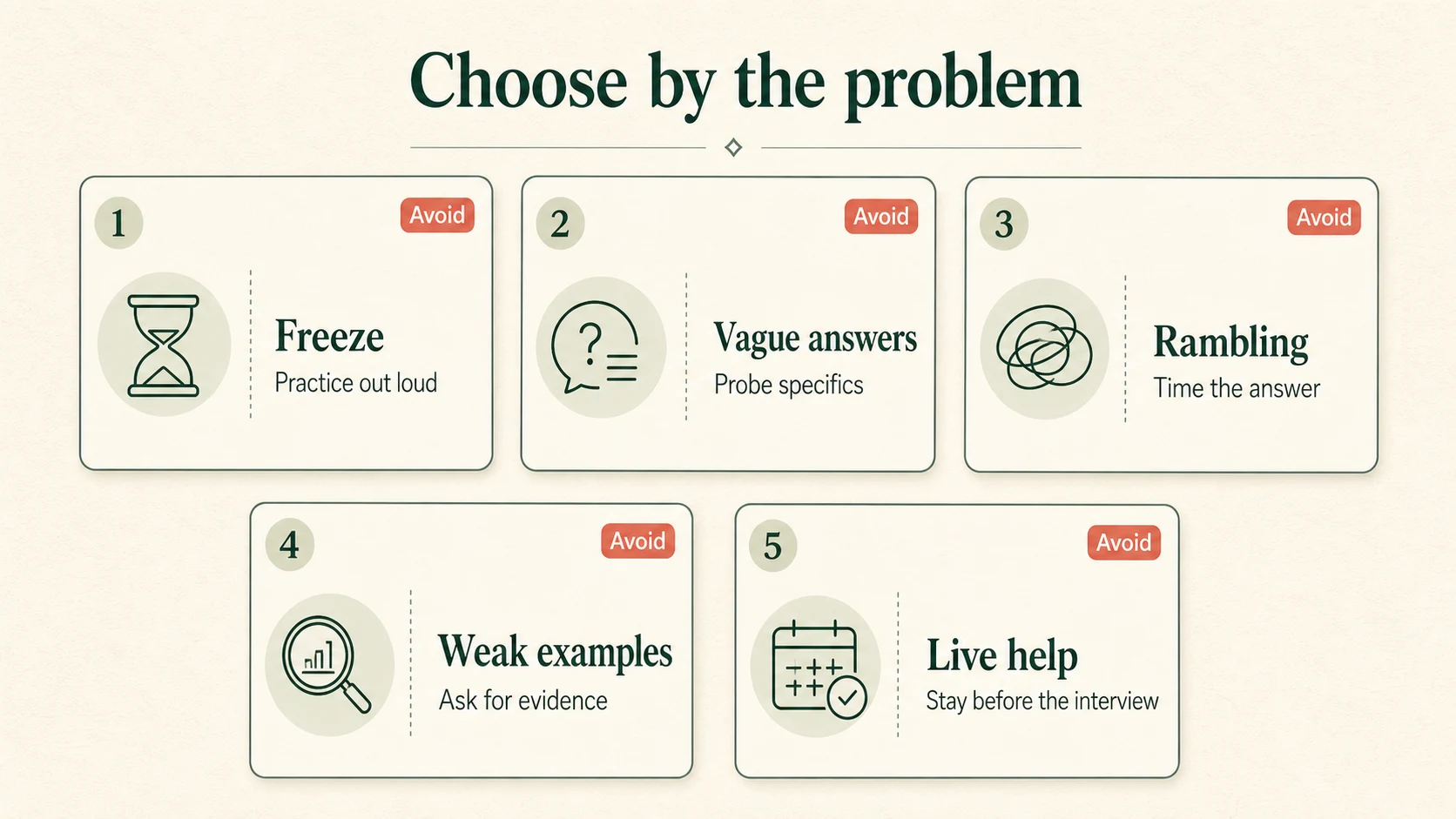
Start with what breaks in the interview, then choose the coach behavior that fixes that specific problem.
| If your interview problem is... | Look for an AI coach that... | Do not optimize for... |
|---|---|---|
| You freeze when speaking | makes you answer out loud and replay the session | long written answer templates |
| You do not know what questions to expect | generates questions from the role and seniority | huge generic question banks |
| Your answers are vague | asks follow-ups about ownership, trade-offs, and results | compliments or confidence scores |
| You ramble | times answers and flags long setup | more elaborate answer structures |
| You lack strong examples | pauses practice until you add real work evidence | invented stories or fake metrics |
| You are tempted by live help | lets you practice before the interview | undisclosed real-time answer feeds |
The AI interview coach checklist
Use this checklist before choosing a tool or starting a session.
| Check | Good sign | Red flag |
|---|---|---|
| Question source | It uses the job description, seniority, and interview type. | It only asks generic behavioral questions. |
| Follow-up behavior | It challenges your specifics: "What did you personally do?" | It rewrites your answer immediately. |
| Evidence handling | It asks you to provide facts before scoring the answer. | It suggests numbers, outcomes, or examples you did not give. |
| Feedback style | It separates content, structure, and delivery. | It gives one vague "confidence" score. |
| Voice control | It helps you keep your own phrasing. | It turns every answer into polished corporate filler. |
| Boundary setting | It works well as practice before the interview. | It pushes stealth or live prompting as the main value. |
The fourth row matters more than people think. A single score feels tidy, but it can hide the problem. You might have strong delivery and weak substance. Or good evidence and a messy structure. You need to know which one is breaking.
Start with evidence, not prompts
AI interview coaches are much better when the input is specific. Spend ten minutes filling this out before the session.
| Field | What to write |
|---|---|
| Target role | The role, seniority, and 3-5 requirements from the job description |
| Interview type | Recruiter screen, behavioral, technical, case, leadership, or final round |
| Work moment | What happened, when it happened, who was involved, and why it was hard |
| Your action | What you personally did, not what "we" did |
| Result | Outcome, number, shipped work, decision, customer signal, or feedback |
| Constraint | Time, budget, politics, ambiguity, conflict, scope, or quality bar |
| Question to practice | The exact question or theme you want to rehearse |
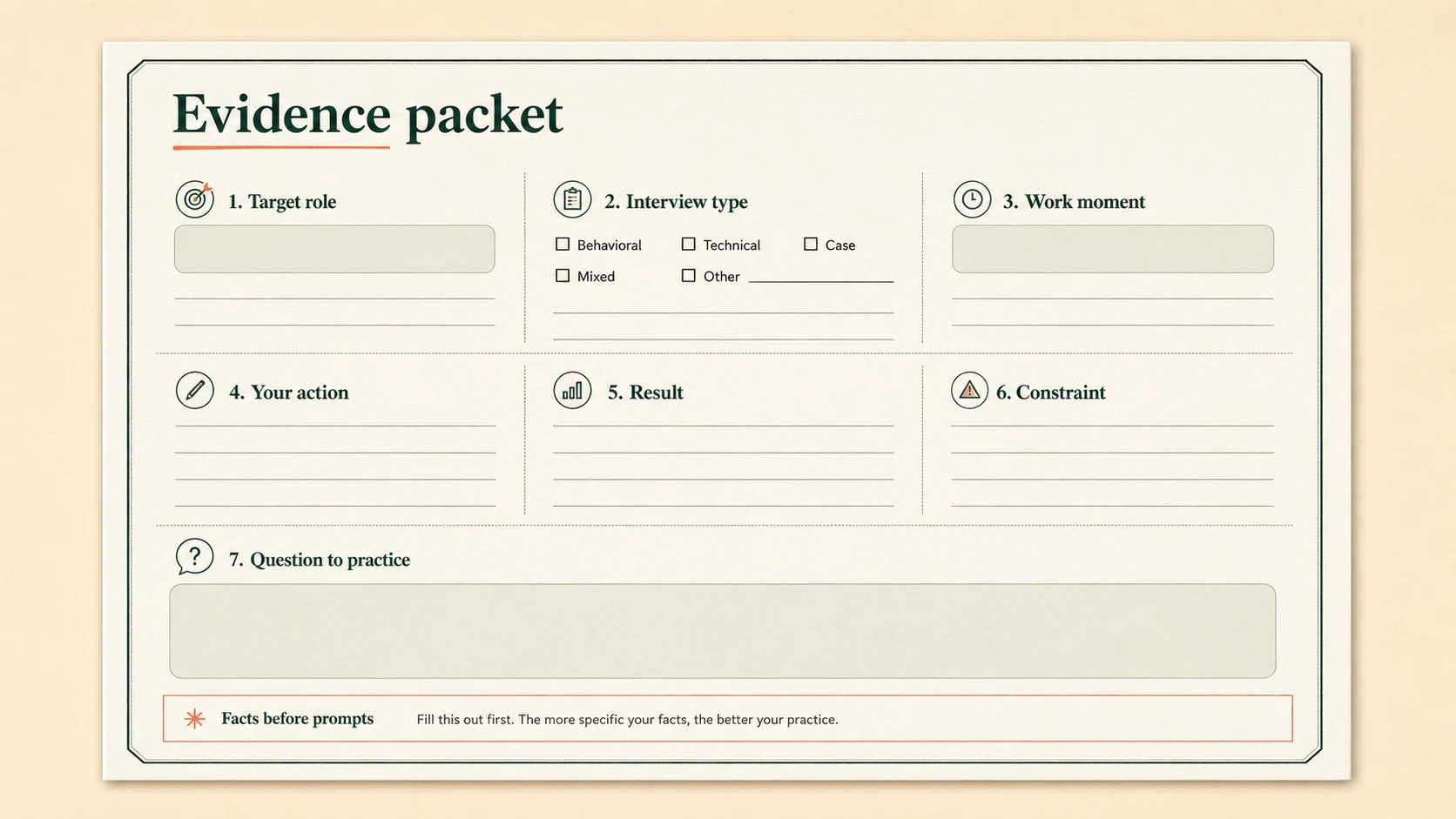
Fill the packet before the coaching session. The quality of the feedback depends on the quality of the facts you bring.
A better prompt for an AI interview coach
Do not ask for the perfect answer. Ask for pressure.
Act as a realistic interviewer for this role: [role and seniority].

Ask one question at a time. After I answer:
1. Ask one follow-up that tests for detail, ownership, or trade-offs.
2. Tell me which part sounded specific.
3. Tell me which part sounded vague.
4. Do not write the answer for me.
5. Do not add facts, numbers, achievements, or examples I did not provide.
6. Keep the feedback direct enough that I can revise the answer myself.

Here is the work evidence I want to practice from:
[work moment, action, result, constraint]
That prompt changes the role of the tool. The AI coach becomes a sparring partner, not a ghostwriter.
Weak use
"Write me a great answer to 'tell me about a time you handled conflict' for a customer success manager role."
Stronger use
"I need to practice a conflict answer. The real moment: a customer wanted a custom renewal discount, finance rejected it, and I proposed a usage-based expansion plan instead. Ask follow-ups about ownership, trade-offs, and the result. Do not invent numbers."
The stronger version is not polished. That is the point. It gives the AI coach enough real material to test, while keeping the facts under your control.
What to ignore in AI feedback
AI feedback often sounds more certain than it should. Treat it like a draft note from a strict coach, not a verdict.
Usually worth taking
- "Your setup is too long."
- "You did not explain your personal role."
- "The result is unclear."
- "You used jargon before giving context."
- "The answer does not match the question."
Check before taking
- "Add a metric."
- "Make the result bigger."
- "Use stronger leadership language."
- "Say this more confidently."
- "Turn this into a success story."
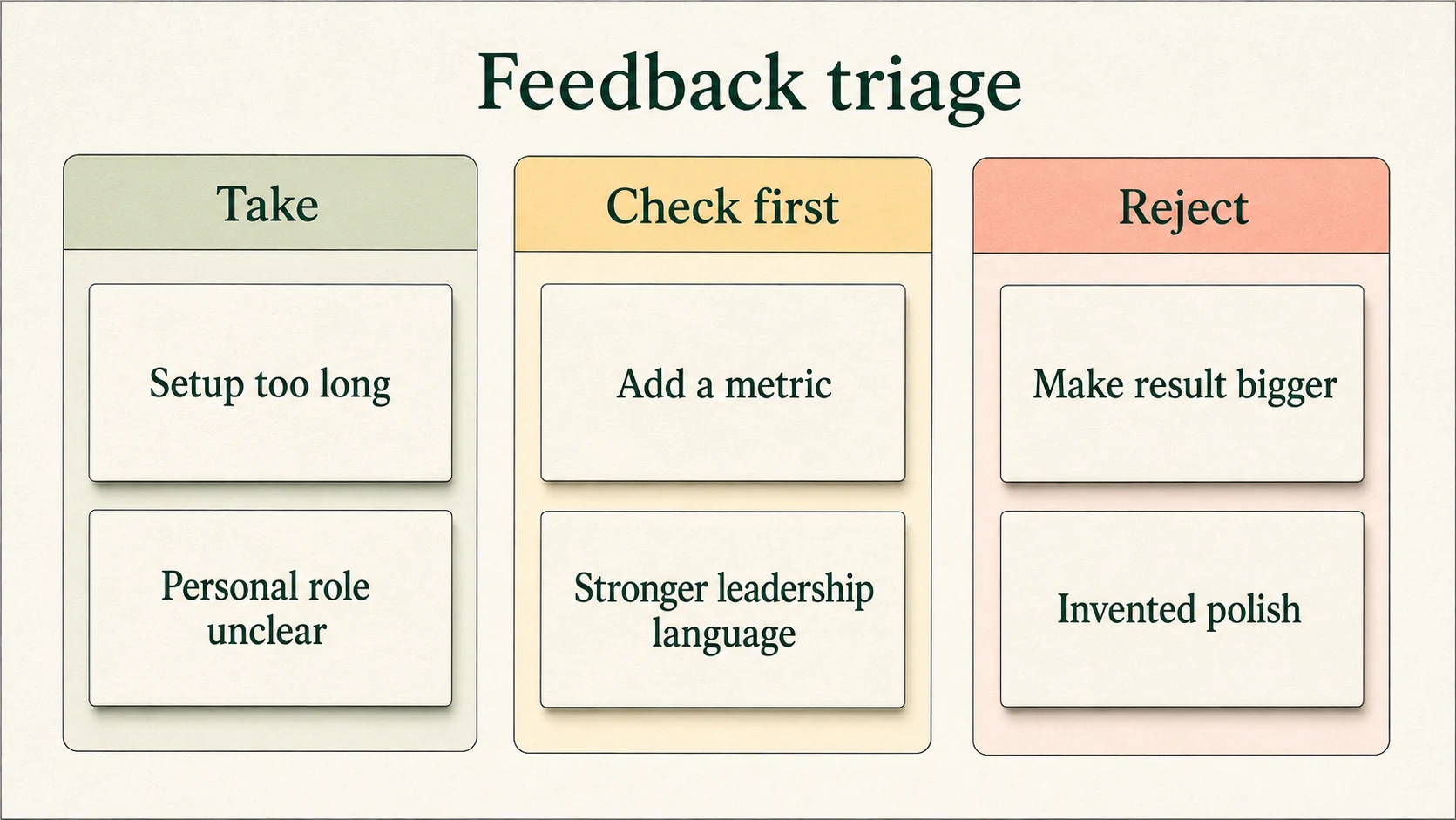
Keep feedback that improves clarity. Check anything that changes facts. Reject advice that makes the story sound bigger than it was.
The second group is where generic answers happen. Sometimes you should add a metric. Sometimes you should not, because the real result was qualitative or the number would be impossible to defend. Sometimes "stronger leadership language" just means replacing a clear sentence with theater.
A three-round practice workflow
- 01
Evidence round
Pick one real work moment and fill in the evidence table. If a detail is missing, find it in old notes, calendars, docs, messages, or reviews before you practice.
- 02
Pressure round
Let the AI coach ask the first question and one follow-up. Answer out loud. Do not read from a script. Mark every place where you had to guess.
- 03
Revision round
Rewrite the answer yourself. Keep your normal voice. Ask the AI coach only to flag vagueness, long setup, missing action, and unsupported claims.
Run this on three to five stories, not twenty. You are not trying to memorize a library of finished answers. You are trying to make a few true stories strong enough to survive follow-up questions.
Where Koru fits
Koru's view is that interview prep starts before the interview appears on your calendar. The hard part is often not "how do I answer this question?" It is "what actually happened in my work that proves I can do this?"
The useful version of an AI interview coach is not the one that makes you sound perfect. It is the one that makes a true answer hold up under pressure.
Related reading
Comparison
Koru vs Career Coaches: AI Tool vs Human Expertise
Compare Koru with hiring a career coach. Learn when AI-powered career tools complement coaching, and when human expertise is worth the investment. They're not mutually exclusive.
Interview Preparation
Best Interview Prep Tools in 2026
Compare the top interview preparation tools for behavioral interviews, STAR stories, and company research. AI-powered prep, mock interview platforms, and question databases reviewed.