 Koru
KoruAI Interview Practice: What It Helps With and What It Misses
AI interview practice can help you rehearse questions, pacing, and follow-ups. It cannot invent the real work evidence that makes an answer credible.
AI interview practice is useful when you treat it like a rehearsal room, not an answer machine. It can ask you a question, push you with follow-ups, point out when you ramble, and make you say the answer out loud before the real interview.
What it cannot do is give you the facts of your career. If you feed it a vague story, it will usually return a smoother vague story. That may feel better in the moment, but it does not solve the problem an interviewer is testing: can you explain what happened, what you did, and what changed because of it?
The best use is simple: bring your own work evidence, ask AI to simulate pressure, then keep only the feedback that makes your answer clearer. Use AI for repetition and friction. Use your own career record for substance.
What AI interview practice is good for
AI practice works best on the parts of interviewing that improve with repetition. You can run through common questions, practice speaking in a two-minute window, and get used to follow-up pressure without asking a friend to sit through the same answer five times.
It is especially helpful when you need to hear yourself answer. A response that feels tidy in your notes can collapse when spoken. You notice the extra context, the missing result, the places where you hide behind "we," and the sentences that sound polished but empty.
Use AI for
- Question exposure
- Follow-up practice
- Pacing and concision
- Spotting unclear structure
- Practicing out loud when nobody is available
Do not use AI for
- Inventing examples
- Adding fake metrics
- Rewriting your voice into corporate filler
- Deciding what your work meant
- Replacing company research or human feedback
What it misses
The weak point is input. AI can tell you that an answer needs more evidence. It cannot know the evidence unless you provide it.
That matters most for behavioral questions:
- "Tell me about a time you handled conflict."
- "Describe a project that did not go to plan."
- "Give me an example of working with ambiguity."
- "Tell me about a time you influenced without authority."
For those questions, the useful material is not a perfect sentence. It is the messy detail: who was involved, what constraint made the situation hard, what choice you made, what trade-off you accepted, what changed after your action.
The practice worksheet
Before you open an AI tool, fill this out for one story. Keep it short. The point is to give the practice session enough real material to work with.
| Field | Write this before practicing | Keep control of this yourself |
|---|---|---|
| Role target | The job title and 3-5 requirements from the job description | Which requirements actually match your experience |
| Interview question | The question you want to practice | Whether the question is realistic for the role |
| Raw work moment | What happened, when, who was involved, and why it was hard | The facts, names, dates, constraints, and result |
| Evidence | Numbers, feedback, shipped work, decision records, customer signals, or scope | Any metric you cannot defend |
| Draft answer | Your rough answer in your own words | Your voice and judgment |
| AI feedback request | "Challenge me with follow-ups and tell me where the answer is vague" | Whether you accept the feedback |
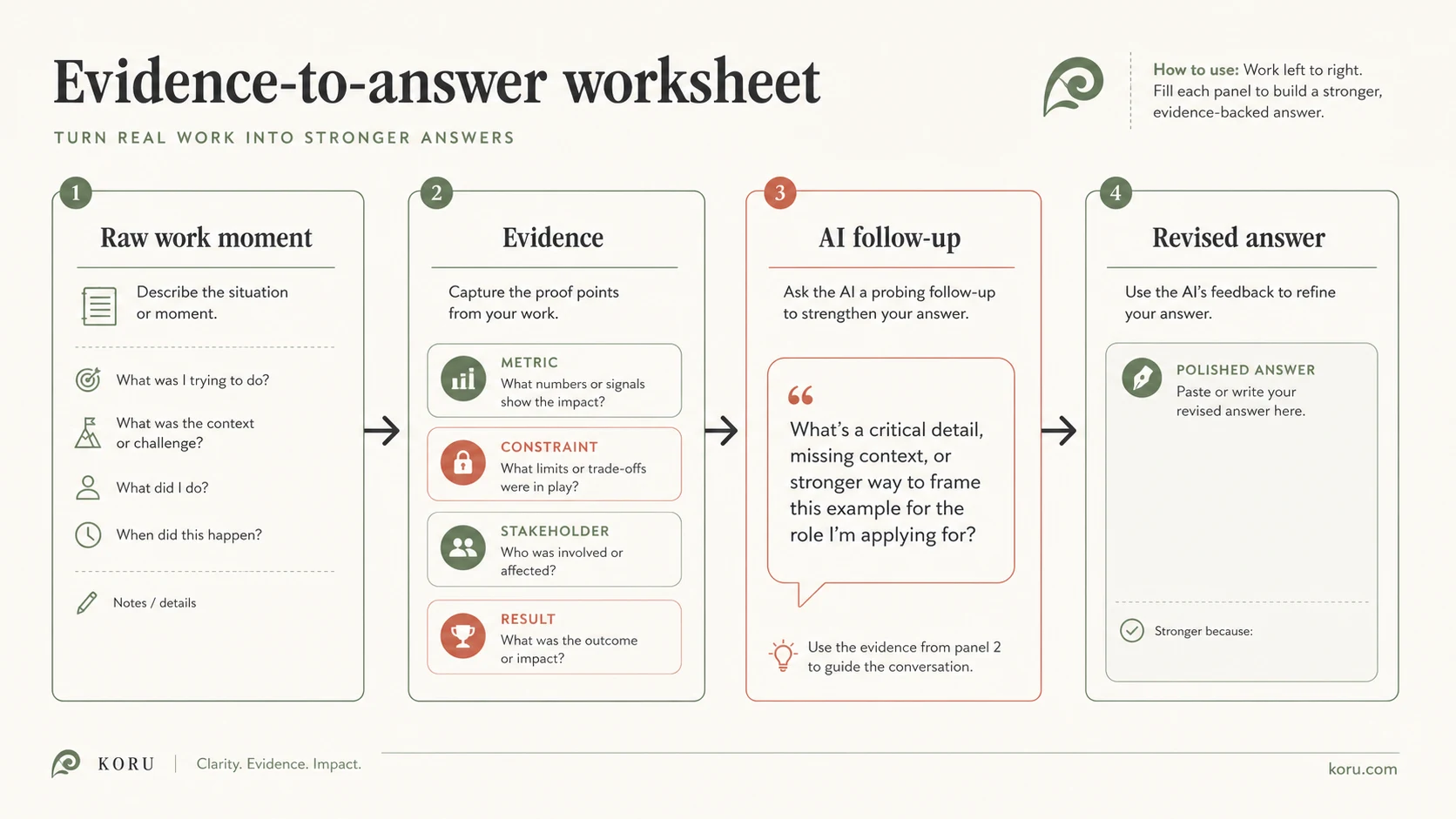
Work left to right. Capture the work moment first, add evidence, let AI ask a harder follow-up, then revise the answer without inventing facts.
Here is a prompt you can use after filling in the table:
Act as a realistic interviewer for this role: [role target].

Ask me one behavioral interview question at a time. After each answer:
1. Ask one follow-up question that probes for detail.
2. Tell me where my answer was specific and where it was vague.
3. Do not rewrite the answer for me.
4. Do not add metrics, achievements, or facts I did not provide.
5. Keep the feedback practical and concise.

Here is the work moment I want to use:
[raw work moment + evidence]
The fourth line is important. Without it, AI tools often try to be helpful by sanding the answer into something more impressive. That is exactly how you end up sounding generic.
Weak answer, stronger practice input
Weak AI input
"Help me answer: tell me about a time I handled conflict. I worked with a difficult stakeholder and solved the issue."
Stronger AI input
"I was the project lead on a billing migration in Q2. Sales wanted a custom exception for one enterprise account. Engineering said it would delay the migration by two weeks. I proposed a temporary manual workflow for that account, got sales to agree to a 30-day limit, and kept the migration date. Help me practice this as a conflict answer."
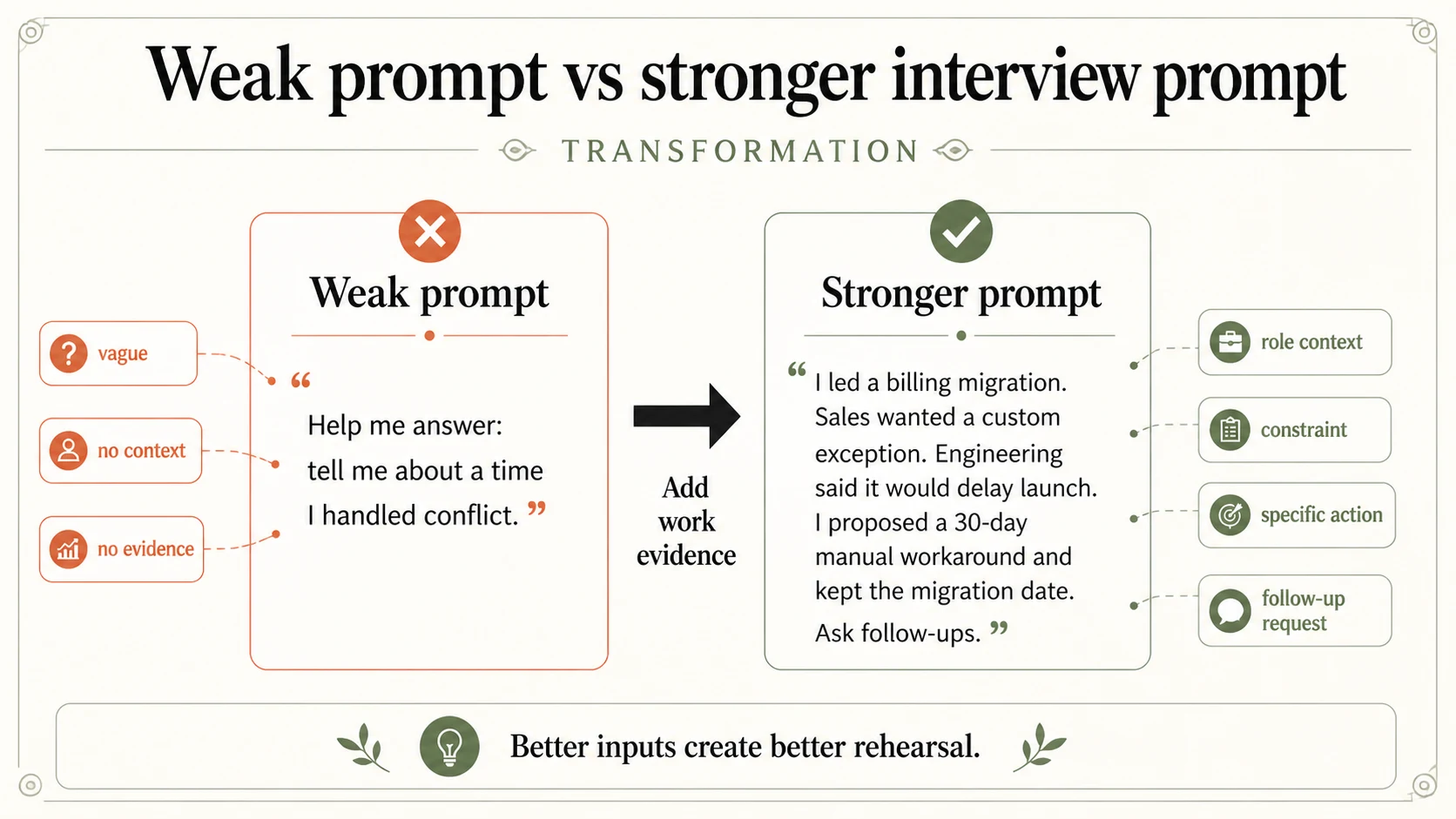
The stronger prompt does not ask AI to invent the story. It gives the tool enough real context to rehearse the story under pressure.
The second version is not beautiful writing. Good. It is useful writing. It gives the practice session constraints, people, action, and consequence. AI can now test the story instead of inventing one.
A three-round practice routine
- 01
Retrieval round
Answer without notes. If you blank, stop and write down which detail was missing. Do not let the AI fill it in. Go back to your calendar, old docs, messages, or career notes and recover the real detail.
- 02
Pressure round
Ask for follow-ups. Good follow-ups usually probe ownership, trade-offs, numbers, conflict, and what you would do differently. If you cannot answer a follow-up, that is useful information.
- 03
Plain-language round
Ask the AI to flag jargon, long setup, and vague claims. Then rewrite the answer yourself. Keep the sentence patterns you would actually use in a room.
This routine is more useful than asking for a "perfect answer." A perfect answer on paper often sounds false when spoken. A specific answer with a few rough edges usually lands better.
How to judge AI feedback
Not all feedback is worth taking. Use this filter:
| Feedback from AI | Usually useful? | What to do |
|---|---|---|
| "Your setup is too long" | Yes | Cut context until the action arrives sooner |
| "Add a metric" | Sometimes | Add one only if you can defend it |
| "Use a stronger leadership phrase" | Usually no | Say what you did instead |
| "Clarify your personal contribution" | Yes | Replace vague "we" language with your actual role |
| "Make it sound more confident" | Maybe | Improve clarity, not volume |
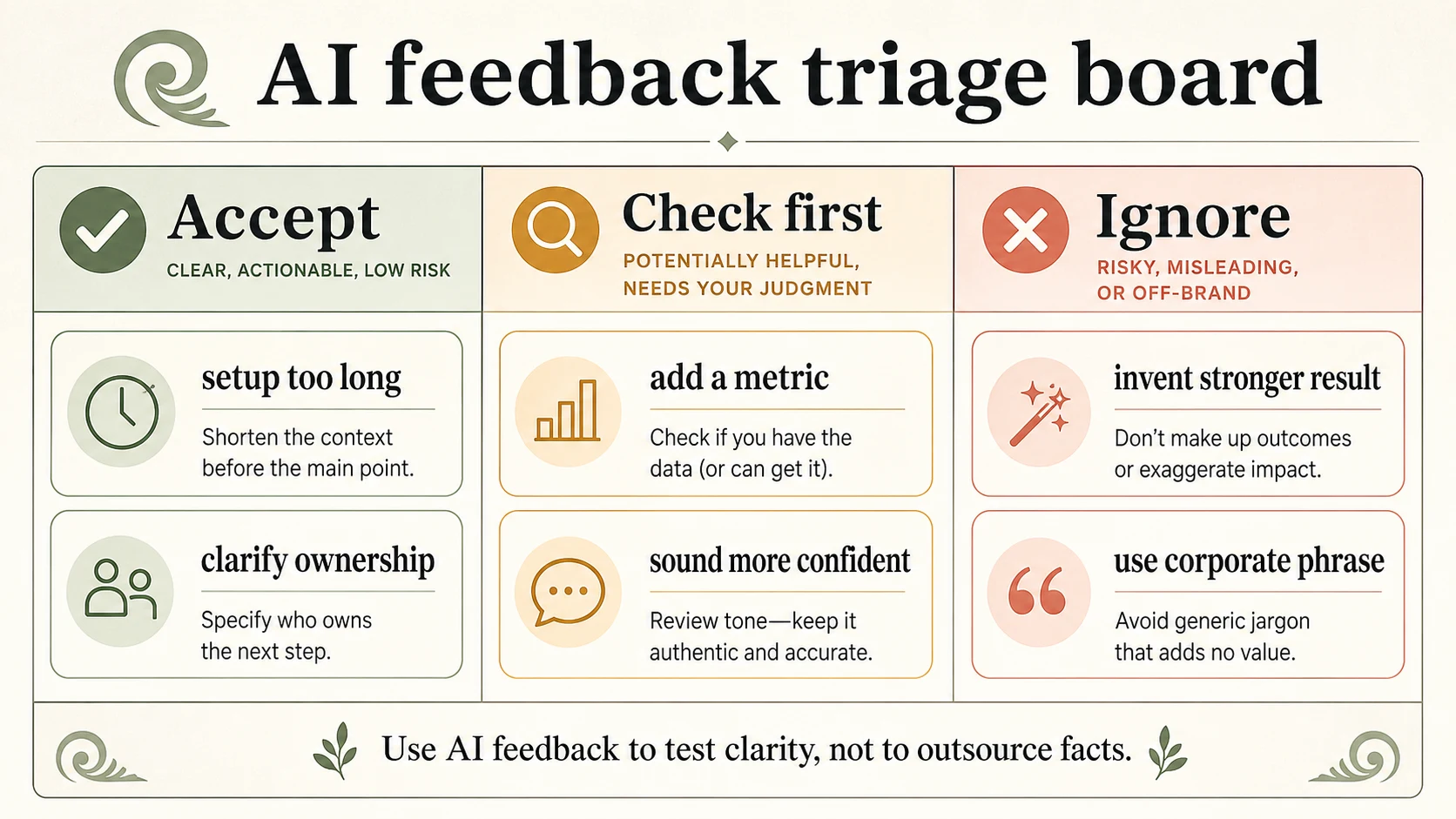
Treat AI feedback like a triage board. Keep comments that improve clarity, check anything that changes facts, and reject advice that makes the answer sound generic.
The point is not to obey the tool. The point is to notice where the answer fails under pressure.
Where Koru fits
Koru's angle is upstream of the mock interview. The hardest part of interview prep is often not practicing the answer. It is remembering the work accurately enough to answer well.
That also protects your voice. A journal entry written close to the work has the texture of what actually happened. The people, constraints, trade-offs, and awkward parts are still there. Those are the details interviewers listen for.
AI interview practice is worth using. Just do not ask it to be your memory. Bring the facts yourself, then let the tool make you rehearse them until the answer holds up.
Related reading
Comparison
Koru vs Career Coaches: AI Tool vs Human Expertise
Compare Koru with hiring a career coach. Learn when AI-powered career tools complement coaching, and when human expertise is worth the investment. They're not mutually exclusive.
Interview Preparation
Best Interview Prep Tools in 2026
Compare the top interview preparation tools for behavioral interviews, STAR stories, and company research. AI-powered prep, mock interview platforms, and question databases reviewed.